
Filming Begins on 'One Flew Over the Cuckoo's Nest'
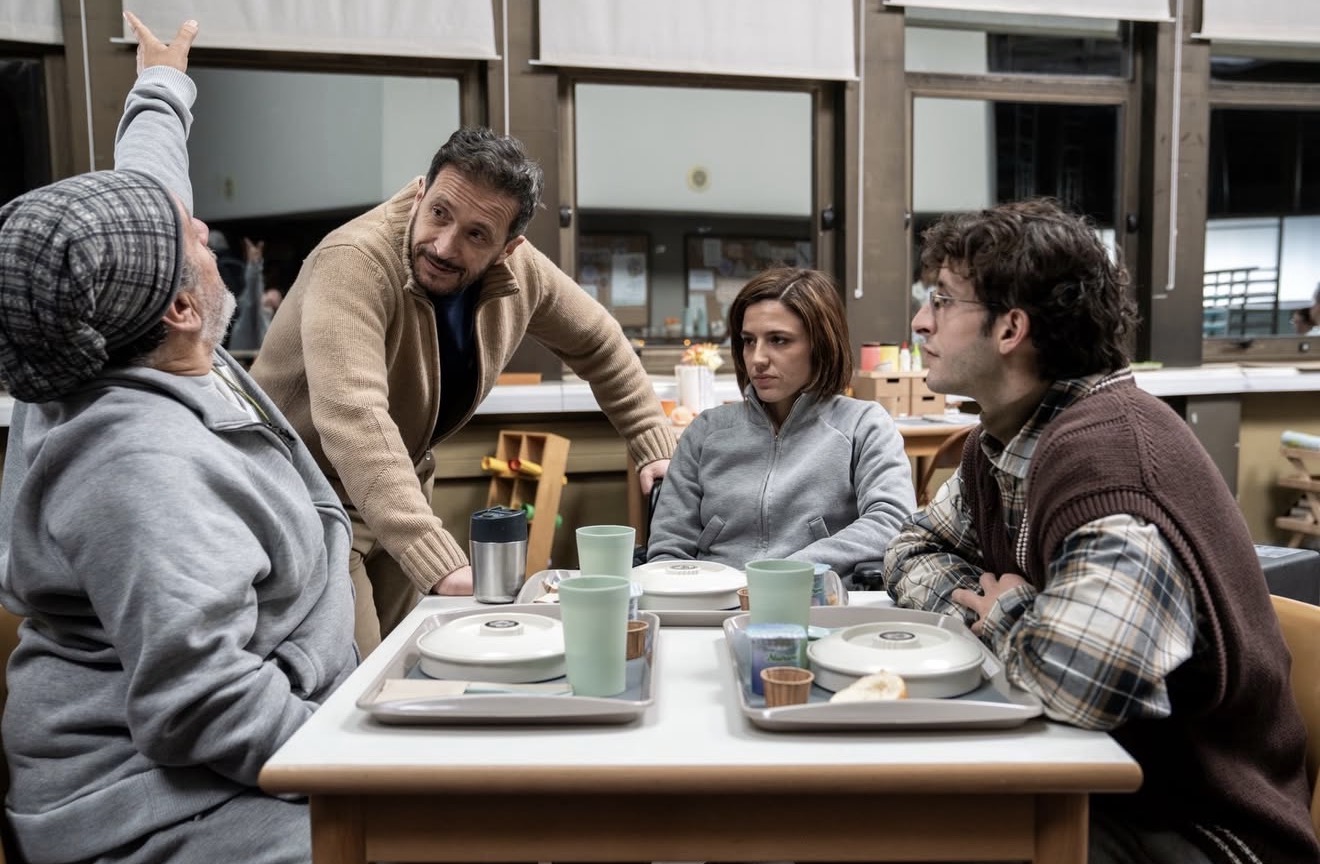
It is difficult to live in a place that, in the eyes of many, is full of “crazy people.” It is even harder to see the humanity in what seems distorted, to see life where others see only chaos. Psychiatric hospitals can be dark and silent places, but light can also shine through in unexpected flashes: the friendship that blossoms between peers, the understanding that slowly takes root, the insight that some had never known until that moment. Even within walls that seem to hold shadows, light can break through—and with it, the possibility of feeling seen, heard, and, finally, human. “...And cut.” The speaker is Salvador Calvo, addressing Pablo Casablanc, Marina Salas, and Daniel Ibáñez. They are seated at a table, though the actress is in a wheelchair.
ABC offers an exclusive look behind the scenes of "One Flew Over the Cuckoo's Nest," the new film directed by Salvador Calvo and written by Alejandro Hernández, which is currently being shot on location in Madrid. This newspaper visits the set, which has been transformed into a kind of psychiatric hospital—but one that is entirely humanized. This new film is an adaptation of the novel of the same name written by Ana Delgado under the pseudonym Sydney Bristow. The book recounts her real-life experience following a suicide attempt. After spending 37 days in a psychiatric ward, Ana chronicles life inside the hospital in the form of a diary: her bonds with other patients, her interactions with medical staff, and her own fears, reflections, and discoveries. Amid moments of pain, humor, and tenderness, the work addresses mental health, the stigma surrounding mental disorders, and personal resilience, showing how, even in extreme circumstances, it is possible to find learning, support, and hope.
“I was really surprised by the humor in the book on a subject like this. It’s very bold. When I read the script, I thought, ‘What kind of movie is this?’” confesses Marina Salas, the film’s lead actress. The book is a kind of diary in which Ana Delgado recounts all her experiences. She tells it in a raw, humorous way, yet with an overwhelming sense of truth. “We were able to speak with her, and she helped us a lot.”
The film set has been transformed into the dining hall of a psychiatric facility. Some of the patients are gathered there. At the far end of the room, three of them are seated at a table, played by Pedro Casablanc, Daniel Ibáñez, and a young actress. Casablanc tells a story, and everyone laughs. Meanwhile, their director, Salvador Calvo, can’t help but laugh from his small makeshift booth made of a black tent. He has each shot sketched out in his hands. He takes off his headphones and says happily, “We’ve got it.” “I wanted to get away from complex and remote locations so I could focus on the characters. It’s what we’d always dreamed of,” he confesses after having had to travel halfway around the world to make ‘1898: The Last of the Philippines’ and ‘Adú,’ for which he won a Goya for Best Director. The screenplay is once again penned by Alejandro Hernández, Goya winner for ‘All the Women’ and a regular collaborator of the director, with whom he has worked on all his feature films.
The place where they’re filming is cold, but at the same time it’s livable. Everything is gray, including the tracksuits they’re wearing and the turban on Casablanc’s head. Yet there’s laughter, humor, and friendship. It’s a place where one can live, even though the reason that brings them there is somewhat painful. “The image you form when reading the script about what the shoot will be like changes a lot from what it actually turns out to be. And that’s what’s truly interesting. It means everything is going well. There are several shifts,” Ibáñez confesses.“I like that more and more—that there’s a big difference between the initial idea, the written script, and what actually comes to be. With another director, it’s a whole different story,” Salas confesses.
“His character is really interesting; that’s what made me say yes to the project, along with Salvador Calvo,” confesses Álex Catalán, director of photography. “Part of my job is to anticipate what’s going to happen, but you can’t control when the characters take shape. Even if you come to rehearsals, you notice the change, and the story evolves in ways you hadn’t anticipated—for the better,” he notes. “It’s a visually naturalistic story, not strictly realistic. It’s a heightened naturalism because, in a way, this clinic isn’t quite like others,” he adds.
Filming continues, and now they have to shoot a scene where Ana, the lead actress, approaches the table where Pablo Casablanc and other cast members are having breakfast. “More energy, Marina,” the director urges. She has to make her way to the table in a wheelchair because she broke her feet after her suicide attempt. It’s not easy to control the force with which she moves toward the table, and as soon as she arrives, she bumps into it slightly and they have to do it again. “Creativity blossoms in the midst of a storm. There are things here that are alive,” confesses Ibáñez.“There’s a challenge every day in approaching this scene as if it were the only one,”he adds. “For me, it’s about finding the delicate balance between giving the material the weight and density it deserves and maintaining the lightness of the film’s tone at the same time,” confesses Marina Salas.
Everyone laughs at the jokes Casablanc tells. It’s a psychiatric ward where people joke around; you can laugh without fear, yet without forgetting why you’re there. “The big challenge is maintaining this balance between humor and drama. There are moments when you’re going to laugh, and then tough things happen. There’s dark humor in the novel that I really like, but just seconds later there’s a twinge and your heart sinks. That walking the tightrope of life is… Well, that’s just how life is. You might be laughing in a funeral home over the loss of a loved one. It’s fundamentally a drama, but it has moments just like real life where humor pops up—and it does so in a shocking way,” the director confesses.
Delving into this story is a challenge for all of us. “It’s a topic that interests me a lot—mental health—and I think it’s essential. I have a daughter, and I think it’s a really important issue. It’s truly very concerning these days; above all, I think we’ve created a society that’s always chasing physical beauty. And that pressure is very intense, especially on young people, who are still figuring things out and are at a very vulnerable stage,” adds Salvador Calvo.
There are several locations where they’re filming, and although today’s shoot is taking place mostly in the dining room, there are also other places like the therapy room, where Ana Delgado herself was surprised to see it and asked for a brochure hanging on the bulletin board. “We believe it’s very important to normalize this, and with this film, I think we’ve succeeded. It’s an issue that has been hidden for a long time. What mainly attracted us to this film is addressing the topic of mental health and trying, through this type of film, to get people to say: ‘Hey, speak up when you need help and don’t let it go,’” says Carla Pérez de Albéniz, executive producer at Fonte Films.
Luis Ferrón, from LAZONA, feels the same way. “I think one of the goals of this film is to strike a balance between talking about mental health without prejudice—which I believe is a very important issue right now, given everything we hear and everything that’s happening—and, at the same time, being able to talk about it without prejudice and without trivializing it,” he explains.
'One Flew Over the Cuckoo's Nest' is a production by Fonte Films, Atresmedia Cine, LAZONA, and Cómo Volé AIE, with the participation of Atresmedia and Netflix and funding from the ICAA, the Community of Madrid, and the Madrid City Council. LAZONA Pictures will handle theatrical distribution, and Film Factory will manage international sales. "It's a good time to make fiction. In the film industry, we’re still trying to regain the ground lost after the pandemic. And here we are. This year has been a good start overall for the box office and for cinema, because there are many very good films. Let’s see if we can stay on this path to recovery. A lot is being done, but now we need to bring it back to the movie theaters,” adds Jaime Ortiz de Artiñano, CEO of Atresmedia Cine.
If there is one thing Salvador Calvo believes in, it is the power of fiction to stir consciences and move hearts. Ana Delgado’s story is not an isolated case; rather, there is increasing discussion of issues that shake the lives of many through eating disorders such as bulimia—which the protagonist describes—and others like borderline personality disorder:“I believe there are many things that can be questioned and, above all, brought to light. Mental health is something that concerns us all; we’ve all had crises, even if we haven’t sought treatment for them. And I believe that therapy and everything related to mental health shouldn’t be a taboo for many people, which right now still seems to be the case. Well, little by little, people are talking about it more, it’s becoming more visible in some way, and I think that’s essential, because visibility is the first step toward healing.”
